Products

.svg)


.svg)


The biggest soccer event of the generation kicks off in June 2026 across 16 North American cities. For print-on-demand sellers, that's a massive commercial window—but also the most aggressive IP enforcement environment you will encounter all year. FIFA and its licensing partners actively monitor e-commerce platforms, and listings that use protected marks get taken down fast.
This guide tells you exactly what's protected, what's not, and how to build a compliant, high-converting 2026 collection using AI design tools the right way.
FIFA holds trademark registrations across dozens of categories in the U.S., Canada, and Mexico—all three host nations. Before you open a design file, you need to know what you cannot touch.
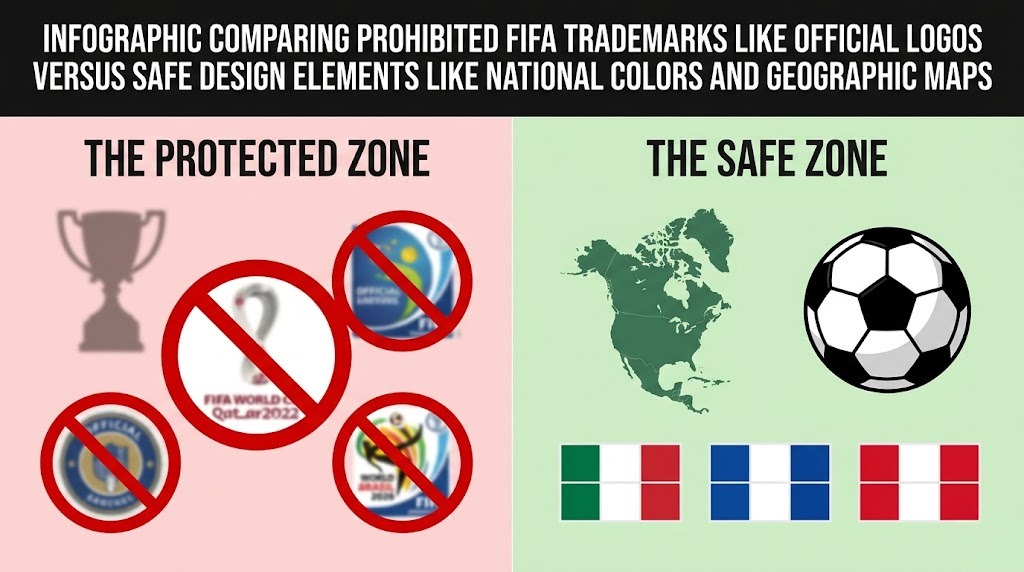
Tournament name and variations. "FIFA World Cup," "World Cup 2026," "WC26," and close phonetic equivalents are registered marks. Sellers have been hit with takedowns for misspellings and abbreviations that still imply the official event.
The official logo and visual identity. This covers the 2026 tournament logo, the trophy silhouette as rendered in official branding, the official mascot, and any official slogan tied to the event. Do not replicate, trace, or closely reference any of these in your designs.
Team crests and federation badges. National team badges—the USMNT crest, Mexico's eagle crest, the Three Lions, the Albiceleste badge—are protected by their respective national federations, not FIFA. The enforcement is just as real. A listing featuring a realistic eagle crest labeled "Mexico" will get flagged.
Sponsor and partner marks. The official sponsor roster brings its own IP layer. Designs that reference tournament sponsorship relationships—even satirically—can trigger claims from both FIFA and the individual sponsor.
Review the GearLaunch Intellectual Property policy before building your first listing, and revisit Copyright & Trademark Basics if you need a refresher on how trademark differs from copyright.
Country names and demonyms. "Brazil," "Argentina," "USA," "Mexico"—geographic terms, not trademarks. Usable in text, product titles, and design copy without IP risk.
National color palettes. Sky blue and white, green and yellow, red white and blue—these color combinations are cultural, not proprietary. Build a design around color story and you're on solid ground.
Flags and national symbols. Flags are not trademarked. Stars and stripes, the maple leaf, the rising sun motif—public domain. Coats of arms and national emblems in their generic form are fair game too.
City names and neighborhoods. "Dallas," "Deep Ellum," "Miami Beach," "Coyoacán"—every one of these is usable. Hyper-local city references outperform generic "soccer" messaging in search and conversion. For a full breakdown of the highest-opportunity host city niches, read Soccer Summer 2026: 5 High-Converting Host City & Fan Culture Niches.
Fan culture language. "The Beautiful Game," "Gol," "Ultras," "Supporter," "Matchday," "Away Days," "90 Minutes"—phrases that aren't FIFA's official slogans are yours to use.
Generic soccer imagery. Balls, boots, nets, pitch line illustrations, stadium silhouettes (not replicating a specific protected venue graphic), and player archetypes are all clear.

Built entirely around a country's color palette and a cultural phrase or city reference. No crest. No badge. No official wordmark.
Argentina example: Sky blue and white diagonal stripe pattern + "Baires" or "La Albiceleste" in a clean sans-serif + generic soccer boot silhouette. Readable as Argentine pride to any fan. Zero IP exposure.
Mexico example: Deep green base, white typography, red accent line + "Tri Nation" or "El Corazon del Futbol" + a geometric eagle silhouette (abstract form, not replicating the federation crest). Converts on cultural resonance, not on trademark use.
Apply these to men's AOP tops and women's AOP tops—the full-surface print area makes the color story far more compelling than a chest-print tee. The AOP athleisure angle is especially strong for 2026; for product and sizing guidance see AOP Athleisure for the 2026 World Cup & USA 250th Anniversary.

Design around the city hosting matches, not the tournament itself. A fan wearing a Dallas-specific matchday piece is wearing local pride—that angle is durable beyond the tournament window and carries zero FIFA exposure.
Tap into the global ultras aesthetic: tifo-style bold graphics, hand-drawn lettering, vintage fan zine layouts. Text-safe phrases that convert: "We Travel Everywhere," "Born To Support," "Supporter Not Spectator," "Away Day Faithful," "90 Minutes. Every City."

This is where most sellers either waste time or create IP risk without realizing it. The issue isn't the tool—it's the prompt. Generic soccer-themed prompts in any image generator will surface crest-adjacent shapes, badge layouts, and tournament logo references because that's what the training data contains. You need to actively steer away from it.
Step 1: Brief generation with Claude or ChatGPT. Before touching an image tool, use a text AI to build a tight creative brief. Prompt: "Write a design brief for a color-block soccer fan t-shirt targeting [Country] supporters. Use only the national color palette, a city reference, and fan culture language. No team crest, no federation badge, no official tournament name or logo. Output: color hex codes, 2–3 typography directions, 1 graphic element idea." This brief becomes your guard rail for image generation.
Step 2: Image generation with Adobe Firefly specifically. Firefly is the right tool here for two reasons beyond just output quality. First, its Content Credentials system tags generated images with provenance metadata—useful documentation if a listing is ever challenged. Second, Firefly's training data is limited to licensed and public domain content, which significantly reduces the risk of accidentally generating something that resembles a protected mark. Use the brief from Step 1 as your prompt, and always include explicit negative constraints: "No logos, no crests, no emblems, no badges, no trophy imagery, no official tournament branding."
A concrete prompt that works: "Minimalist streetwear graphic, abstract geometric eagle in red and green on a white ground, sans-serif text reading 'El Norte', clean composition, no logos, no emblems, no crests, flat vector style." The eagle is a cultural reference; the geometric abstraction keeps it out of crest territory.
Step 3: Typography and layout in Canva Magic Edit or Adobe Express. Use these to finalize color palette accuracy against your national color reference, add and adjust type, and export to GearLaunch's product templates. Both tools have built-in resize workflows for apparel and accessories. Run a quick visual comparison against the actual team crest before you finalize—if a fan has to look twice to tell them apart, redesign.
Step 4: Text element check in USPTO TESS. Before any listing goes live, run your text elements through USPTO's TESS database. This catches registered marks on phrases you might assume are generic. Takes two minutes per phrase and is the single most skipped step in POD design workflows.
Step 5: Add a disclaimer to every listing. "Independently designed fan apparel. Not affiliated with FIFA, any national federation, or any official tournament sponsor." One sentence. Signals good faith to platform review systems and buyers alike.
Do use: Country names · national flag colors · city and neighborhood names · fan culture phrases · generic soccer imagery · original illustrations in a national color palette · public domain national symbols and flags · Firefly-generated graphics with negative prompting
Do not use: "FIFA World Cup" or any abbreviation · "WC26" · official tournament logo or visual identity · national team crests or federation badges · official mascot · official slogan · any phrase implying official sponsorship · player names or likenesses

POD sellers researching compliance search for: World Cup 2026 trademark rules, FIFA IP safe zone POD, print on demand soccer designs with no copyright risk, World Cup merch without license.
Design-focused sellers look for: AI soccer fan design 2026, Firefly soccer apparel prompt, IP-safe sports merch AI, how to design World Cup fan apparel without crest.
Platform sellers building collections target: World Cup 2026 fan merch ideas, soccer supporter apparel POD, host city fan gear 2026, color block soccer apparel print on demand.
What exact phrases does FIFA trademark for the 2026 tournament? FIFA registers the tournament name, official slogans, mascot name and image, the official logo, and the trophy as rendered in official branding. For the U.S., verify current registrations via the USPTO TESS search tool. When in doubt, rephrase or remove.
Can I use a country's national color palette without their crest? Yes. Color palettes are not protectable as trademarks. Sky blue and white, green and yellow—these are cultural identifiers, not owned marks. The moment you replicate a specific crest or badge shape, even in abstract form, you're in protected territory.
Is it safe to use "World Cup" in my listing title? No. "World Cup" in reference to the FIFA event is a registered mark. Use descriptive alternatives instead: "2026 Soccer Summer," "North America 2026," "Global Football Fan," or host city references.
Browse the full GearLaunch AOP catalog to find the right products for your 2026 fan collections. Ready to build your first IP-safe design? Start creating today.


.svg)
.svg)
.svg)