Products

.svg)


.svg)


Most Halloween selling advice treats October 31st like a cliff edge — list your skeletons and ghosts in September, sell hard for four weeks, then watch the category go dead overnight. That's not a seasonal strategy, it's a sprint, and sprints are expensive: every design gets one shot at a narrow window, ad spend can't amortize past the holiday, and the day after Halloween a seller is starting from zero on Thanksgiving creative.
Pumpkins break that pattern. They're not a Halloween motif that also happens to work in November — they're a harvest motif that happens to peak in October, which means a single pumpkin-first campaign can run from late summer through Thanksgiving without a hard stop. That's the strategic case for building this campaign around pumpkins instead of "spooky": it turns one design push into a 10-to-12-week revenue window instead of a two-week one.
This guide covers the campaign side of that strategy — when to launch, why the competitive math favors pumpkin over "scary," how to bundle the lineup, and when to actually retire pieces. For design specifics and per-product pricing on the four items in this collection (throw pillows, mugs, Halloween windsocks, and porch flags), see the companion Product Selling Guide.
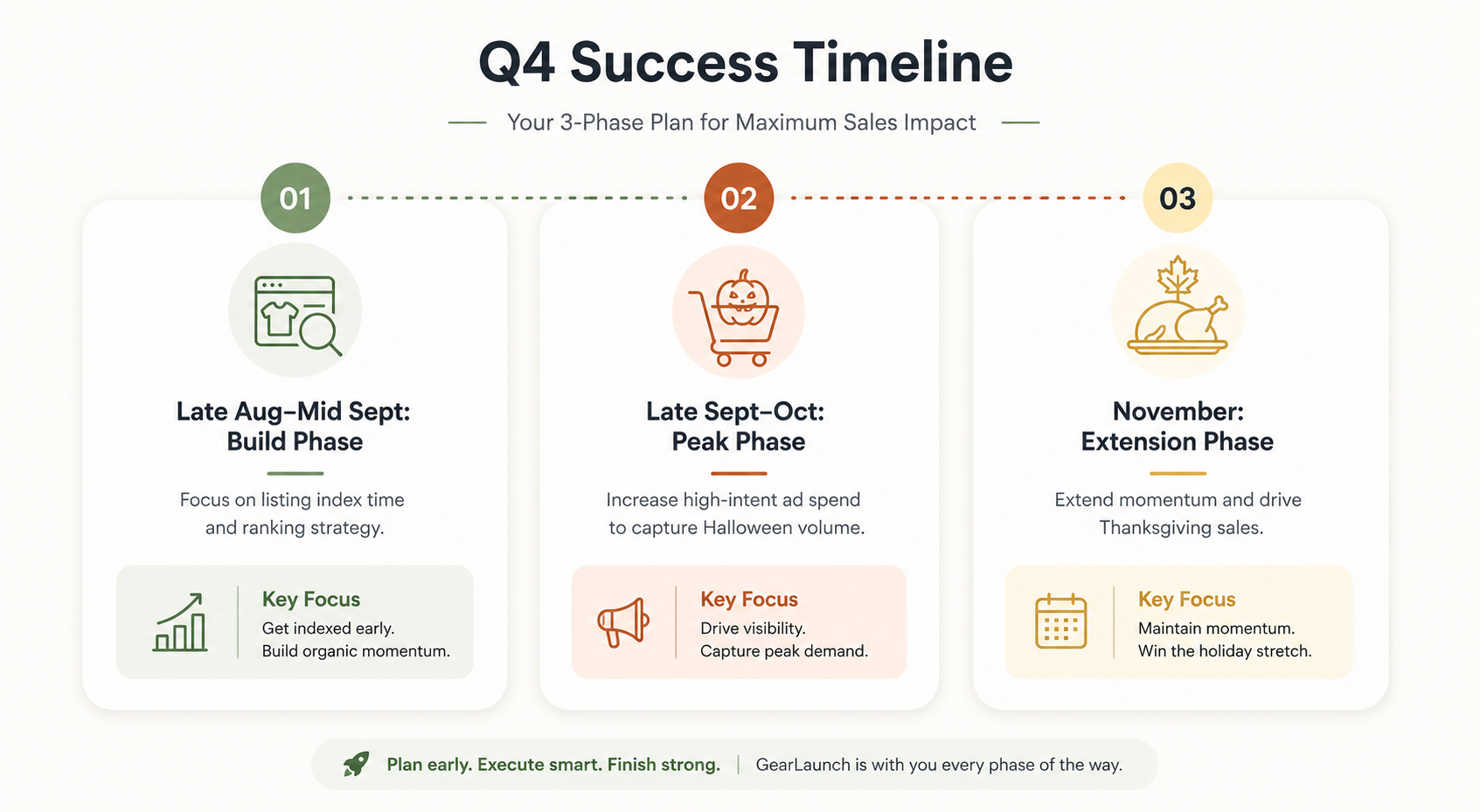
Fall home decor search interest climbs in late August, roughly six weeks before "Halloween" as a search term spikes in early-to-mid October. Most sellers miss that first window entirely because they're still designing skeleton and witch artwork that only makes sense once October actually arrives. A pumpkin collection can go live during that quiet stretch, which matters for two reasons: new listings need lead time to accumulate reviews and search ranking, and there's dramatically less competition in late August than there will be in three weeks.
Phase one — late August to mid-September (build phase): List the full collection now, even though traffic is still low. This is when a listing earns the ranking history that makes it competitive once volume arrives. Outdoor pieces (porch flags, windsocks) should go first, since porch decorating typically starts before indoor decorating.
Phase two — late September through October (peak phase): This is where a pumpkin collection competes head-on with straight Halloween listings, but on friendlier terms — it's catching both the "Halloween" shopper and the broader "fall home" shopper who isn't searching for anything scary at all. Consider a modest ad push here, since this is genuinely the highest-intent window.
Phase three — November (extension phase): Nearly every skeleton, ghost, and witch listing goes quiet on November 1st. A pumpkin pillow or mug doesn't — it still belongs on a Thanksgiving table. This is the phase that a "scary"-first collection simply doesn't get access to, and it's the clearest return on having built pumpkin-first from the start.
The case for pumpkin-first isn't just about longer shelf life — it changes the economics of the whole campaign.
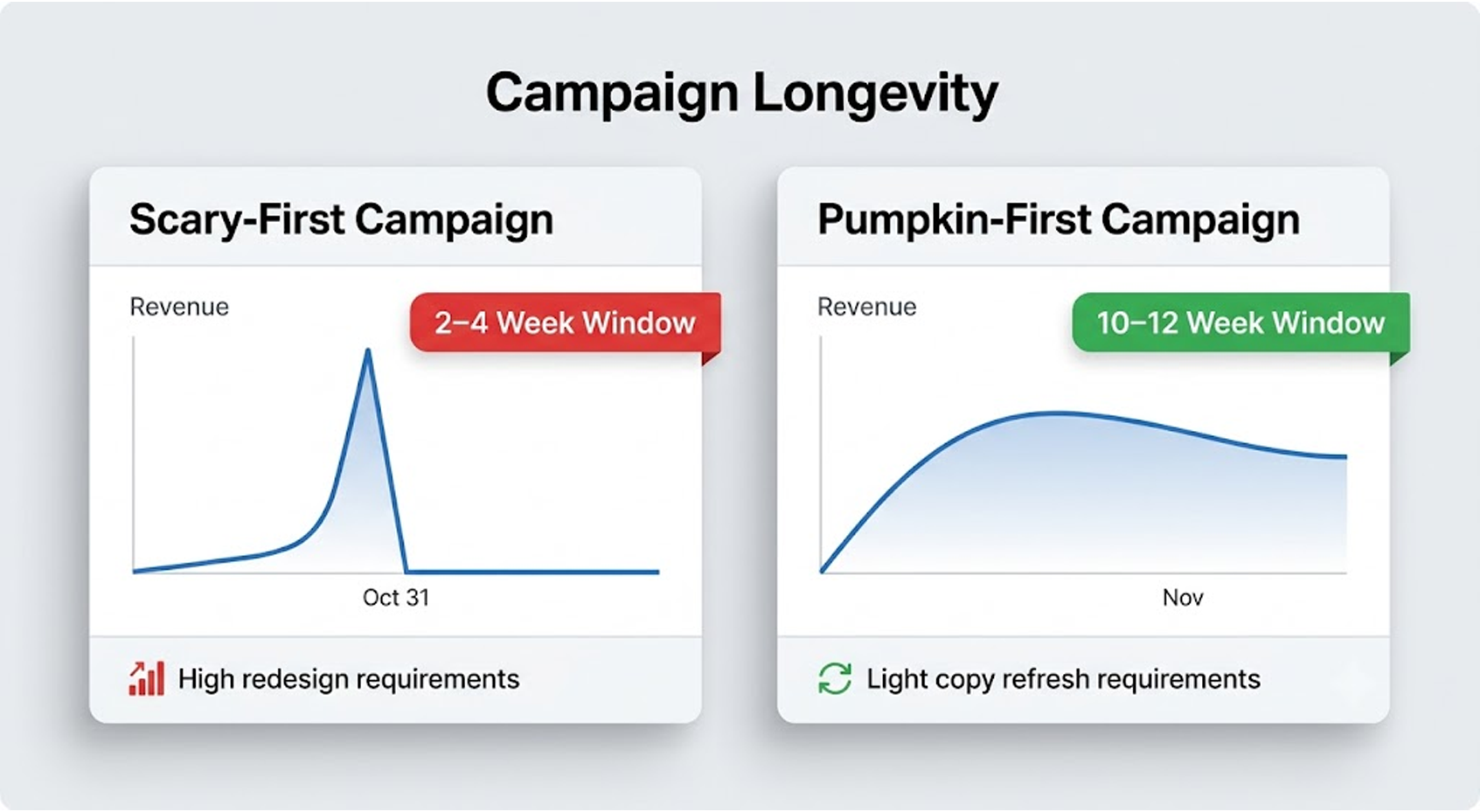
Lower creative turnover cost. A seller running skeleton-and-ghost Halloween designs typically has to redesign for Thanksgiving from a standing start on November 1st, since cornucopias and turkeys share almost no visual language with witches and spiders. A pumpkin collection needs, at most, a light copy refresh — "cozy fall" language can shift to "grateful season" language without touching the artwork.
Lower competitive density in the build phase. By the time October hits, the Halloween category is saturated with last-minute listings from sellers who waited for the obvious search spike. A pumpkin collection listed in late August faces a fraction of that competition while it's building ranking, which is exactly the period when ranking is hardest to earn.
Better ad spend amortization. If a single campaign and creative set can run 10–12 weeks instead of 2–4, the cost of building that campaign (design time, initial ad testing, listing optimization) gets spread across three to four times the selling window. That's a real reduction in cost-per-unit even before accounting for the extra November revenue.
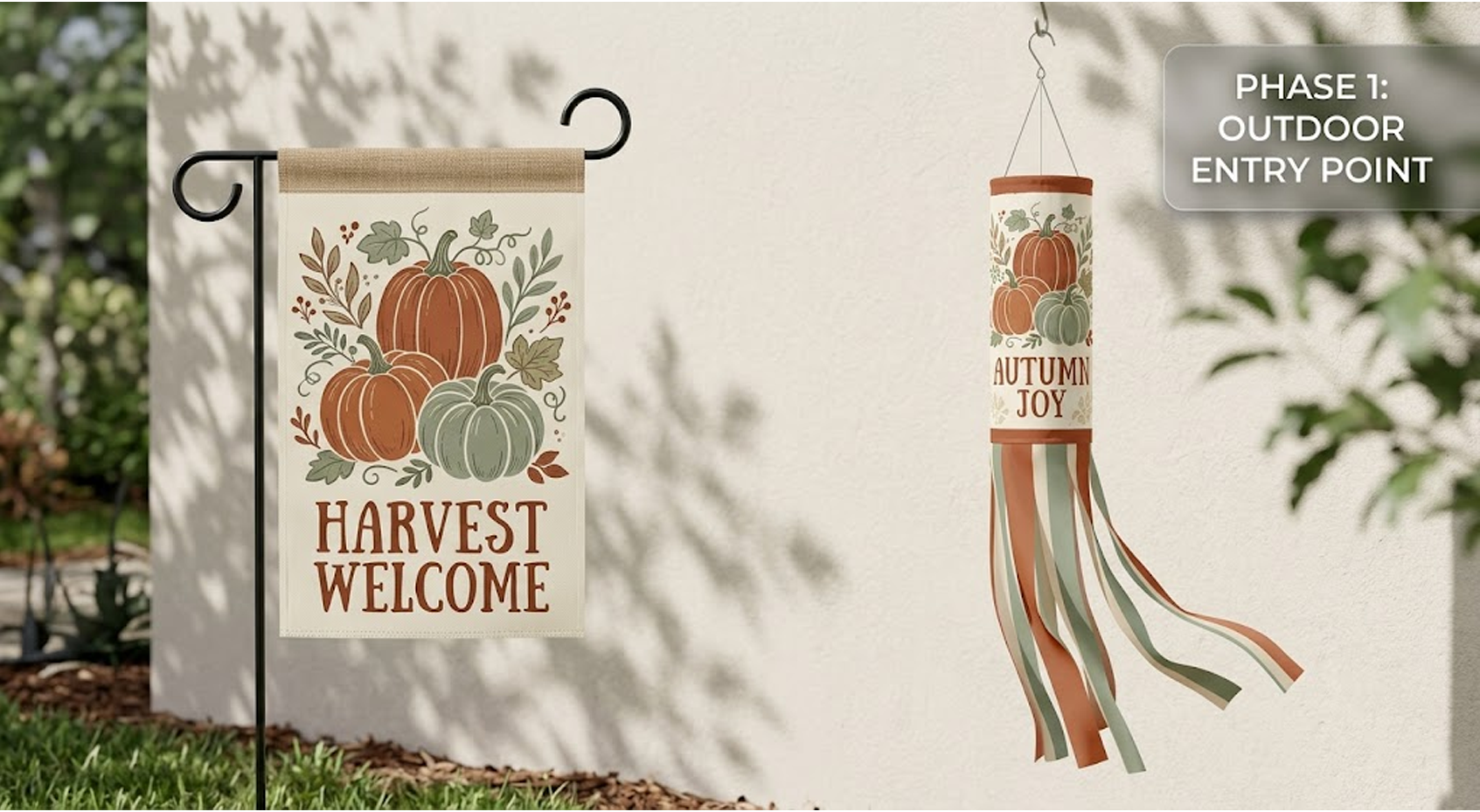
The four products in this collection split naturally into an "outdoor" pair and an "indoor" pair, and that split is the backbone of a bundling strategy rather than an accident of the product list.
Porch flags and the Halloween windsock are what a shopper buys first, when they're decorating the outside of the house. Throw pillows and mugs are what the same shopper buys two or three weeks later, once they start bringing the fall aesthetic indoors. Framing these as a "porch to table" journey — rather than four unrelated SKUs — gives a natural upsell moment: a buyer who orders a porch flag in early September is a strong candidate to be retargeted for a pillow-and-mug bundle in late September, once they're clearly already committed to redecorating for fall.
That sequencing also solves a design-consistency problem. Because all four pieces share the same muted, cottagecore palette — rust, sage, cream, rather than neon orange-and-black — a shopper who buys the windsock in August and the mug in October ends up with a set that actually looks intentional together, which is a stronger case for the bundle than four designs that merely share a theme name.
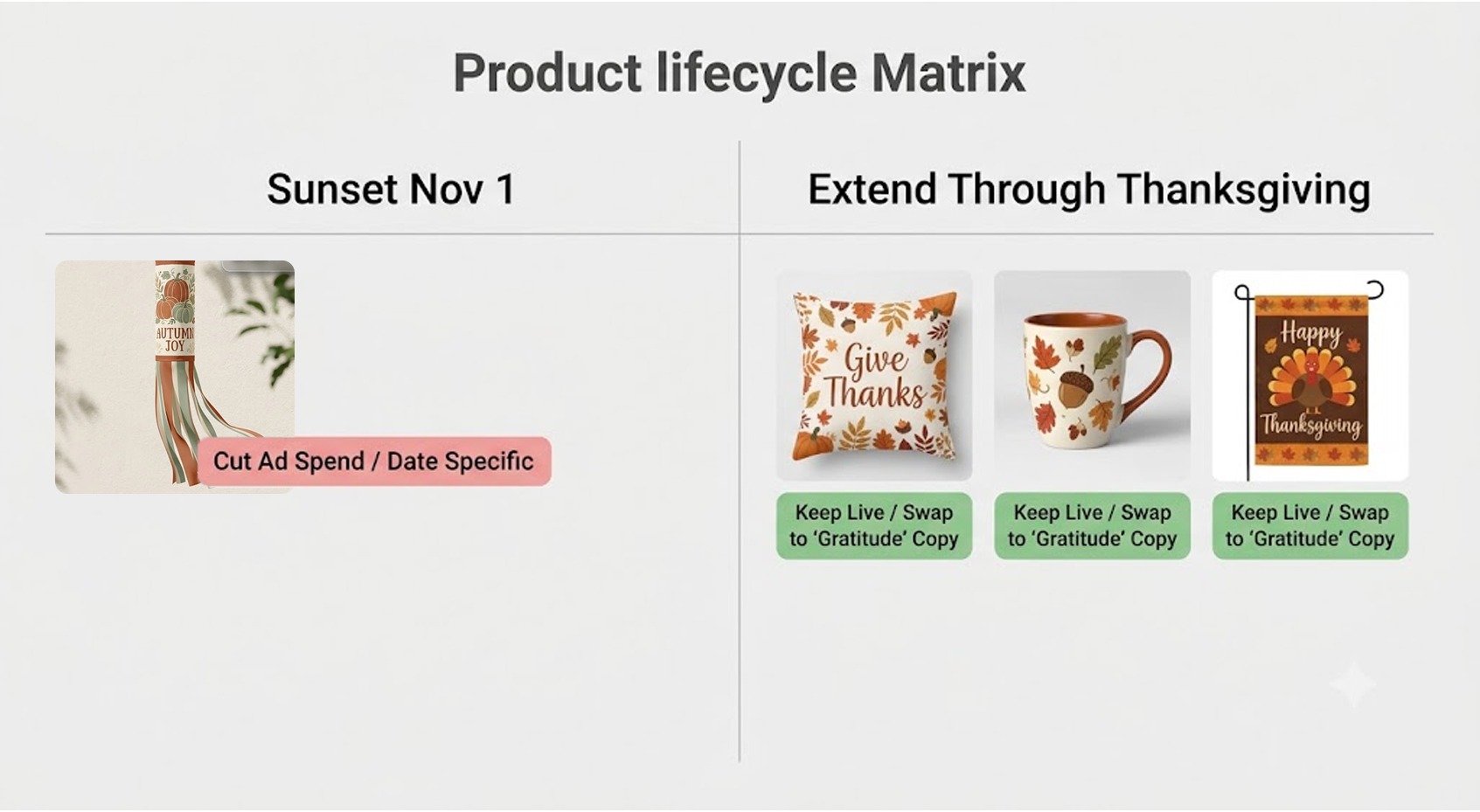
Not every product in this collection should stay listed at full visibility through Thanksgiving, and treating them all identically wastes ad budget on items that are past their peak.
Sunset around November 1st: The Halloween windsock is the one product in this lineup that says "Halloween" by name, and its sales curve will drop hard once the date passes regardless of palette. Pull ad spend off it in the last week of October rather than waiting for the sales data to confirm the drop.
Keep live through Thanksgiving: Throw pillows, mugs, and porch flags all read as general harvest decor and don't need to come down. A light copy adjustment — swapping "cozy fall" for "gratitude season" in the listing description — can extend their relevance without a design change.
Consider relisting in a Thanksgiving-specific collection: Sellers who want to keep momentum past Thanksgiving weekend can carry the pillow and mug designs into a dedicated Thanksgiving guide with harvest-table styling, since the artwork doesn't need to change — only the surrounding campaign does.
When should I launch a pumpkin-themed fall collection? Late August to early September — roughly six weeks before Halloween search volume actually spikes. Listing early gives a design time to build reviews and search ranking before the October rush, when competition is at its highest.
Why does a pumpkin-first strategy outperform a "scary"-first one on ROI, not just shelf life? Because the campaign and creative investment gets amortized across 10–12 weeks instead of 2–4, and because the design carries into Thanksgiving with only a copy refresh instead of a full redesign — both of which lower the effective cost per sale.
Which product should carry the ad budget as October ends? Shift spend away from the Halloween windsock in the last week of October, since it's the most date-specific item in the lineup. Throw pillows, mugs, and porch flags can keep running through Thanksgiving with little to no adjustment.
Should these four products be sold as separate listings or one bundle? Both, ideally in sequence — list them separately so each can rank on its own search terms, but retarget porch-flag and windsock buyers with a pillow-and-mug bundle offer once they've shown they're actively decorating for the season.
Does this calendar apply the same way in the Vietnam and Bangladesh markets? The pumpkin/harvest association is strongest in markets where Halloween and Thanksgiving are both culturally present. In regions where Thanksgiving isn't observed, the November "extension phase" logic may not carry the same weight, and the campaign may be better scoped to end closer to Halloween.


.svg)
.svg)
.svg)